Commercial Air Conditioning
Servicing Local Businesses & Commercial Builders
We specialise in air conditioning equipment as well as fixed rate maintenance and repairs.
Redtech Commercial Refrigeration has proudly designed, constructed and maintained heating/cooling systems for commercial businesses for over 17 years.
With strong ties to the local community, we are grateful for the opportunity to service schools, hospitals, nursing homes and more.
Redtech specialise in Commercial Air-conditioning for small, medium and large-scale applications like office buildings, factories, and retail spaces. Such environments involve a range of specialised solutions and product types for product cooling or workforce/customer comfort. The best system depends on factors like the building’s size, layout, specific cooling/heating needs, and energy efficiency goals in conjunction with the business’ needs.
Reach out to us for consultation and advice.
No Job is Too Big or Too Small
We offer a wide range of commercial heating/cooling solutions for businesses, commercial builders and the local government. We custom design our systems to suit all preferences, budgets and job sizes.
Our Clients
- Restaurants
- Cafes
- Wineries
- Supermarkets
- Farms
- Food Processing Facilities
- Bakeries
- Florists
- Sporting clubs
- Nursing homes
& More
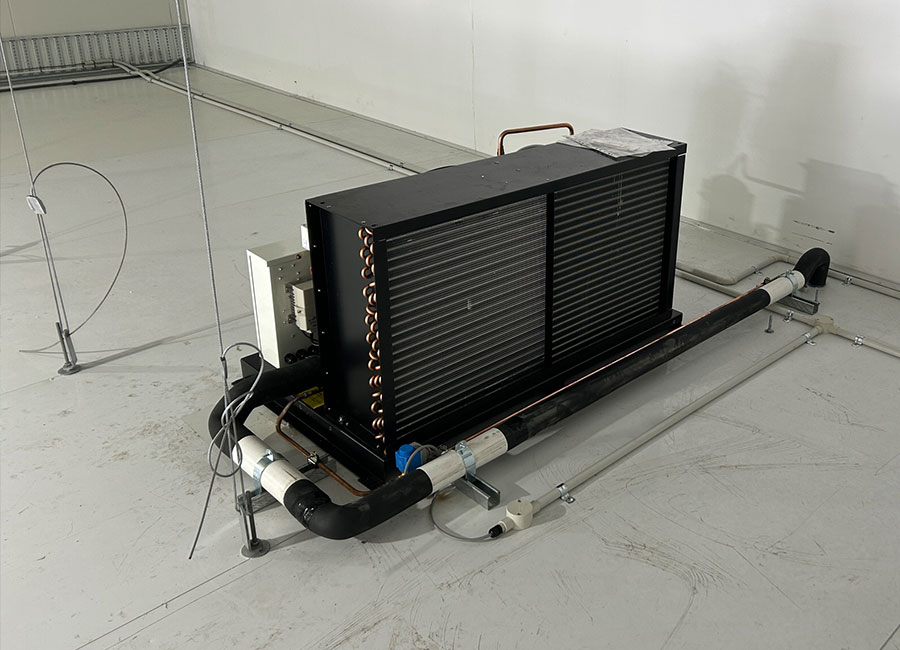
Commercial Air-Conditioning Solutions
1. Rooftop Units (RTUs) or Packaged Systems
These are incredibly common across South Australia, especially for large-format commercial buildings.
- You’ll find these on the roofs of nearly every Bunnings Warehouse, Coles, or Woolworths supermarket, as well as on countless single-story office parks and light industrial facilities. Their robust, all-in-one design makes them well-suited for the harsh Australian sun and outdoor conditions.
2. Variable Refrigerant Flow (VRF) Systems
VRF systems are gaining significant traction in South Australia’s commercial sector, particularly in new developments.
- With the push for energy efficiency and NABERS ratings (the National Australian Built Environment Rating System), VRF is becoming the system of choice for new, high-end office towers and elaborate, new corporate buildings. Their ability to provide zoned control is perfect for modern open-plan offices and co-working spaces. The simultaneous heating and cooling capability is useful for managing temperature differences between a sun-drenched northern side and a shaded southern side of a building.
3. Split Systems
Split systems, including multi-split configurations, are a staple for smaller commercial applications.
- A typical small business, cafe, or boutique retail store in a suburban strip will almost certainly use a split system for its cooling. They are also common for providing supplementary cooling to specific areas within a larger facility, such as a server room in an otherwise un-air-conditioned warehouse.
4. Chiller Systems
Chillers are the workhorse for Australia’s largest and most iconic commercial buildings.
- The air conditioning for major CBD high-rise office buildings, large hospitals, and shopping centers like Westfield malls is powered by chiller plants. The efficiency of a water-cooled chiller system is critical for managing the significant heat load generated in these large spaces, especially during a hot South Australian summer.
5. Air Handling Units (AHUs) and Fan Coil Units
These are the distribution components of larger systems.
- In humid work environments AHUs often include specialized dehumidification functions to ensure occupant comfort. Fan Coil Units FCUs are a very common solution for providing individual temperature control in multi-unit developments like hotels and apartment buildings, where each room needs its own thermostat.
6. Specialised Solutions for Factories and Manufacturing
The diverse climates in Australia influence the choice of specialised systems.
- Evaporative Coolers: These are a very popular and cost-effective solution for warehouses and workshops in Australia’s hot, dry inland regions and in cities like Adelaide and up north. Their low running costs make them an attractive option for cooling large, open spaces, despite their limited effectiveness during periods of high humidity.
- Ventilation and Exhaust: In manufacturing plants, particularly those dealing with high heat (e.g., steel fabrication) or chemicals, industrial-grade ventilation and exhaust fans are a non-negotiable part of the building’s design, crucial for both employee safety and equipment performance.
If you are looking for a NEW COMMERCIAL AIR-CONDITIONING SYSTEM, CONTACT US FOR A CONSULTATION AND QUOTE.
Responsive and Responsible for…